
Reconstruct George County Former Owners Transfer by Transfer
A backward chain works through a parcel's history one transfer at a time. Start with the newest deed and move back. Log every conveyance as its own link in the chain. For each instrument, pull the names, dates, and parcel details from the recorded document itself. Gaps tempt shortcuts. Resist them. A similar name does not prove the same person. A tax-roll entry alone is not evidence of a deeded transfer. Let the recorded deeds carry the weight.
| Transfer date | Grantor to grantee | Instrument type | Book and page |
|---|---|---|---|
| Newest conveyance | Prior owner to present grantee | Warranty, quitclaim, tax, heirship, or other deed | Copy exact citation |
| Earlier acquisition | Earlier grantor to that prior owner | Read from the image | Follow cited prior reference |
| Probate or court link | Estate, executor, heirs, or ordered recipient | Probate, heirship, partition, or court conveyance | Save case and land-book references |
| Pre-1910 segment | Parties in predecessor geography | Jackson or Greene County record | Verify with the custodian |
Every row in your chain must trace back to records tied to the subject parcel itself. Dates, parties, deed types, and citations give the property records weight even when names or parcel numbers shift.
Start With the Latest George County Deed
The George County Official Records Portal accepts grantee, grantor, date, instrument, book/page, legal description, parcel, PPIN, subdivision, lot, and section, township, and range criteria. Search with the most specific keys tied to the current parcel. A hit can return file date, parties, and consideration. It can also list related instruments and a deed image to download.
The portal needs a registered subscription. It also warns that the courthouse index controls the record. An incomplete entry? Visit the Chancery Clerk at 355 Cox Street or call 601-947-4801. Remember that a deed of trust, release, or lis pendens can touch the record. It can do so without ever creating a former owner.
Walk the George County Deed Chain in Reverse
The grantor on the newest deed becomes your next search target, this time as an earlier grantee in George County property records. Precise prior book and page references beat broad name searches every time, so chase them first and keep the legal description beside every name you collect.
- Open the current deed and capture grantors, grantees, date, instrument number, and prior references.
- Search its grantor as a grantee in an earlier range using the same land description.
- Open that acquisition deed, add it to the timeline, and repeat with its grantor.
- When web results stop, move the known book/page to historic or courthouse books.
- Grantor / grantee
- The transferring and receiving parties.
- Reverse index
- An index organized by the grantor side.
- Warranty / quitclaim
- Different deed forms whose effect must be read from the instrument.
- Chain of title
- The ordered sequence of records affecting the same land interest.
Move George County Book and Page Into the Historic Index
An official-record type, book, and page opens the door to older images in the Historic Virtual Index. Its own instructions send users to the SI index first. Hundreds of pages were back-scanned over time. The images remain informational rather than official, so weigh them accordingly. The interface itself offers the controls a researcher needs. Those controls push a former-owner chain deeper into George County deed records.
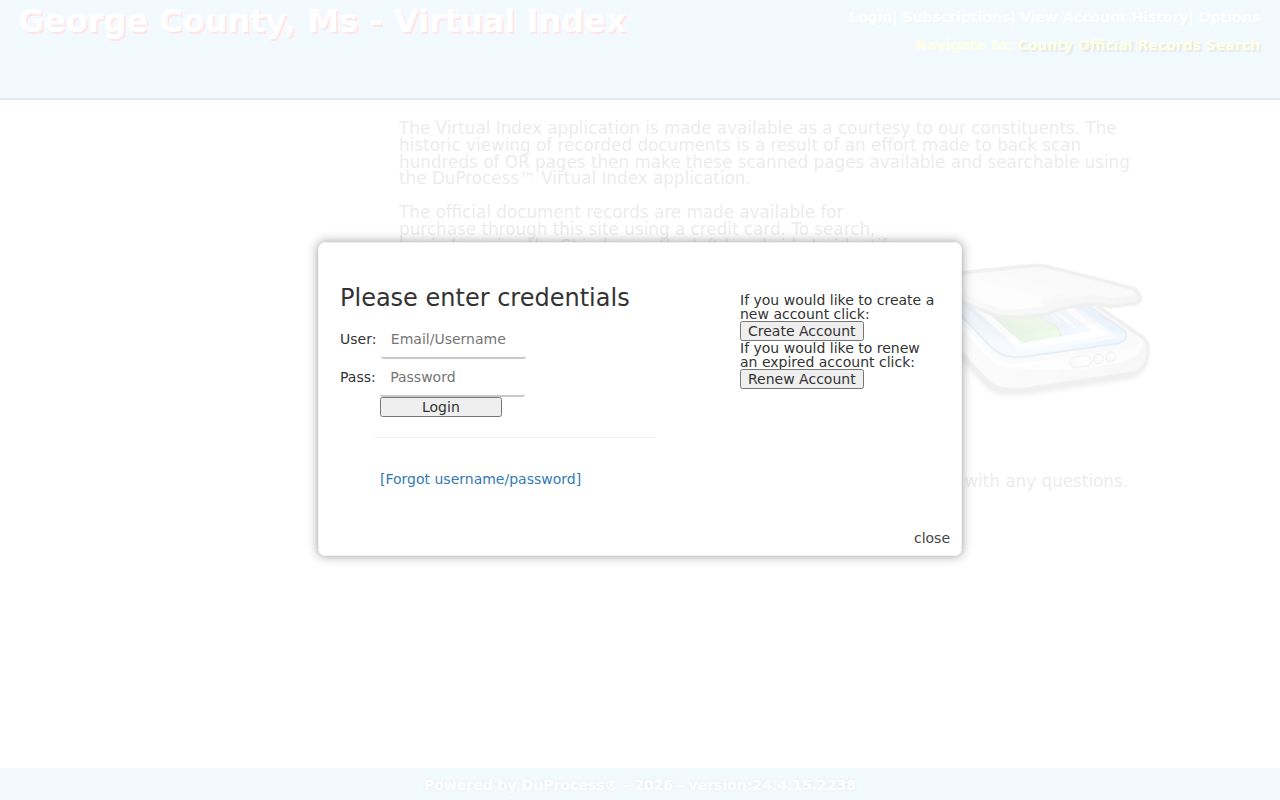
What if the cited page is missing? Take the reference to the courthouse General Index of Deeds, the Sectional Index, plat books, and probate indexes. A no-result means you should change channels, not that no George County transfer ever happened.
Interpret George County's 31-Year Scan Statement
The Chancery Clerk reports that 31 years of land records were digitally scanned. The scans are stored off-site. That is a preservation fact. It is not a published start year for the searchable portal. The clerk also states that all land records are online. Yet the portal says its index is not official. Both claims matter when you weigh coverage.
George County has never published one earliest online index year. Coverage may be unclear. Call the clerk with parties, book and page, parcel key, instrument type, and date range in hand. Do not stretch the 31-year statement into an unsupported cutoff date for your property search.
Cross the 1910 George County Record Boundary
George County was organized in 1910 from parts of Jackson and Greene Counties. That year marks the start of the modern county record system. It is not the first conveyance of the land itself. Earlier links in the chain may shift custodians. That depends on which parent county held the property. Anchor the current legal description first. Trace it back to the earliest George County citation. Then use the MDAH county-records catalog to locate microfilm and parent-county series.
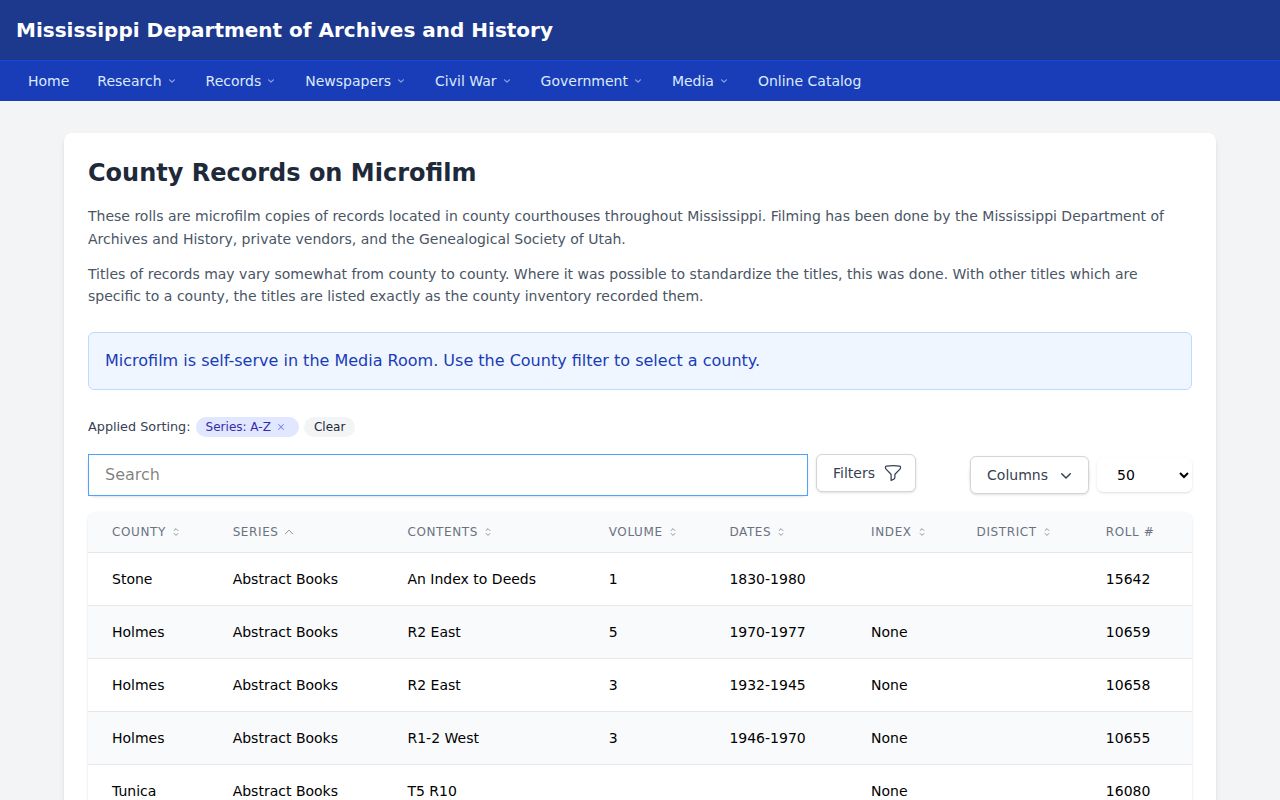
MDAH describes its county microfilm as self-serve in the Media Room. Treat the catalog as a finding aid only, and verify each deed with the county custodian that holds the record.
Bridge George County Probate and Heirship Gaps
A sale-to-sale chain can snap when an owner dies or a court reshapes an interest. Dig into wills, probate and estate files, executor or administrator deeds, heirship records, partitions, quiet-title cases, tax deeds, and redemptions. George County's Chancery office keeps both land and probate records under one roof.
Search trust, estate, fiduciary, married-couple, and entity name variants exactly as written. The portal's Related Instruments, From Parties, To Parties, Property Details, and Filer Information fields help separate a true transfer from a mortgage, release, or notice.
Hold George County Prior Owners to the Same Land
Street names and parcel keys change over time. Older rural tracts may carry no useful address at all. Preserve subdivision, block, lot, section, township, range, acreage, adjoining calls, and every line of the legal description. Compare the recorded plat against the deed. Never treat tax-map geometry as the legal boundary.
The courthouse Map/Plat Book and Sectional Index help here. MDAH, FamilySearch, and the Lucedale-George County Library can supply context and catalog leads. Still, only the recorded instruments themselves establish the ownership chain.
Follow George County Legal Descriptions Across Time
When owner names drift across decades, the legal description is your sturdiest thread. Copy every line from the newest deed. Then compare those lines with the legal fields in the parcel layer. For a subdivision parcel, keep the subdivision name, block, and lot. Also keep the plat book and any replat citation. For rural land in George County, keep section, township, range, and acreage. Also keep corners, courses, distances, and roads. Include water features and adjoining owners.
Never modernize spelling or abbreviations on your own. A subdivision may be styled one way in a deed. It may look different on the plat, and a third way in a zoning ordinance. An old owner may appear as initials in one index. The same owner may appear as a full name in another. Source wording, kept intact, lets the next deed-records search broaden deliberately. It does so without inviting a false match.
Tax parcels also split, combine, or get reassigned after an older transfer. When a PPIN or parcel ID changes, compare acreage and parent-tract language. Also compare prior book and page references and the plat. The modern tax map is a finding tool. It does not prove that its polygon captures every historic deeded interest in the land.
Place George County Past Owners in the Record Timeline
Timeline work benefits from a few anchor dates. The courthouse went up in 1911, soon after George County organized. It earned its Mississippi Landmark designation in 1989. The Chancery office keeps the county land books. Local newspaper holdings run from the 1910s forward. They can surface probate notices, tax-sale notices, and useful context for a parcel's past. Newspaper items stay leads, though. Each one should point back to a filed deed, a court case, or an estate record. Only then does it count as ownership evidence.
Modern layers carry their own dates. George County's Chancery court joined Mississippi Electronic Courts in 2016. The clerk now describes a revamped digital filing system. The land portal has required a web subscription since May 2020. These milestones describe access, not ownership. A former-owner timeline should always separate the date of a conveyance from the date its image became viewable online.
The Historic Virtual Index and the off-site scan program guard older material well. Neither publishes one complete coverage chart. Label each source honestly. Call it an index result, a recorded image, an archival catalog entry, a newspaper lead, or a legal conclusion. Then a compelling house history never hardens into an unsupported title claim.
Audit the George County Backward Chain for Gaps
Trace back as far as possible. Then read the timeline oldest to newest. Confirm that each grantee later appears as the grantor, or that a probate, court, tax, or entity record explains the change. Compare legal descriptions at every link. Flag shifts in acreage, lot number, spouse, trustee, company name, life estate, mineral reservation, or parent-tract wording.
Gaps deserve a narrow second pass. Search a tight date band around each one for related instruments. The portal's From Parties, To Parties, Related Instruments, Property Details, and Filer Information fields can expose a correction or a companion filing. Try both party roles and reasonable name variants. Still, do not add a former owner unless the instrument shows a transfer affecting the subject land.
Preserve citations and copies in the order used. Note the portal or office, search date, index terms, instrument number, file date, book and page, deed type, and image status. Name the source explicitly whenever a conclusion rests on a courthouse book, an MDAH roll, or a parent-county volume. A transparent gap beats a seamless but invented chain.
Separate George County History Leads From Ownership Proof
History sources earn their place in a parcel search. Historic inventories, cemetery material, obituaries, newspapers, and family catalogs can surface names, addresses, dates, and relationships worth testing. MDAH's Lucedale property inventory and the library's Mississippi materials are strong for house history. FamilySearch catalog entries point toward land, probate, death, marriage, cemetery, and county-history collections. None of them replaces the deed chain.
Use each lead to frame the next official search. An obituary may suggest an estate date range. A historic-property entry may supply an earlier street address, or a cemetery and family record may explain why an heirship name appears. Then return to the Chancery deed, probate, court, tax-sale, plat, or parent-county book that records the land event. Mark any unverified address-to-parcel match as provisional.
The 1910 boundary makes this discipline vital. A family could occupy the same land before and after George County formed, while the relevant earlier deed still sits in Jackson or Greene County. Continuity alone settles nothing. Let the legal description and the predecessor geography decide where the chain moves next.
Know How Far George County Former-Owner Records Reach
Local guides trace George County Chancery land and probate records to the county's 1910 organization. Online indexing is not complete, though. When the digital trail thins, the fallback chain runs through courthouse books. It also reaches the Historic Virtual Index, MDAH microfilm, and parent-county records. No source reports a destructive fire. No official record describes any courthouse blaze wiping out these land books.
Coverage limit. George County does not publish one earliest online year. Older former owners may require deed books, archival microfilm, and Jackson or Greene County records.
The 1911 courthouse holds its designated Mississippi Landmark status. The portal even lists a Certificate of Mississippi Landmark instrument type. That pairing shows how research works. An archival fact is a lead. A recorded citation is property evidence. Use former-owner findings for lawful title, estate, purchase, or house-history work. Never use them to harass or target any living person.
Test George County Former Owners Against Other Instruments
A name that drops out of the deed sequence is rarely a dead end. Inspect the instrument types near the gap. The county index lists foreclosure deeds, county and city tax-sale records, releases, life-estate deeds, cemetery deeds, mineral and royalty deeds, oil leases and assignments, mobile-home real-estate certifications, and joint-tenancy or entirety deeds. Those labels explain missed events. A broad search can overlook exactly the filing that changed an interest.
Keep ownership and encumbrances separate. A deed of trust secures debt, so its substitution or cancellation does not automatically name a new owner. Lis pendens signals litigation, not the winner. Mineral rights can travel apart from the surface estate. Before adding anyone to the prior-owner timeline, read the parties, legal description, related instruments, and the final recorded document.
Request Missing George County Ownership-History Records
A good records request starts with the right details. Name the Chancery Clerk as the custodian. Then pinpoint the parcel by PPIN, parcel ID, situs, legal description, and any known book and page. Say exactly what you want: deeds, deeds of trust, easements, plats or replats, liens, tax-sale and redemption papers, corrections, probate filings, or court records. Add a date range so the clerk can scope the search. Ask for electronic copies and a fee estimate. Request any index entry or metadata the office already keeps, too.
The Mississippi Public Records Act opens nonexempt records to the public. It allows cost-based charges for searching, reviewing, copying, and mailing. It stops short of requiring the clerk to build a title chain for you. Older George County ownership history may sit outside the courthouse. Then contact MDAH or the parent county with the exact series and citation. A narrow, well-cited request closes gaps far more often than a blanket ask for everything tied to a family name.