
Inside George County Tax Records
Each George County screen answers a different question. The appraisal result lays out the tax-roll parcel and its value. The real-property tax search is where you inspect the bill. It also shows the payment state. For cross-reference, the county GIS adds tax district, exemption, homestead, and component-value fields.
| Field | What It Shows | Where |
|---|---|---|
| Owner and parcel keys | Tax-roll name, Parcel ID, and PPIN | Delta appraisal and GIS |
| Value components | Land, improvement, and total value fields | Appraisal and parcel layer |
| Exemption context | Exemption code, homestead, and tax district | Parcel layer and assessor |
| Bill and payment status | Current tax liability and posted payment data | Delta real-property tax search |
| Tax-sale follow-up | Sale, deed, release, or redemption trail | Tax Collector and Chancery land index |
Assessed value is the slice used in the tax formula. True or market value is a separate appraisal idea. A deed's consideration is a recorded transaction field. None of these is the parcel's current sale price, so never relabel one as another.
George County Tax Search Fields
George County runs two Delta forms. The real-property appraisal search takes name in last-name, first-name order, address number and street, parcel number, and PPIN. The real-property tax search adds section, township, and range fields. No field is marked as required.
| Search field | Appraisal | Tax bill |
|---|---|---|
| Owner name | Last, first | Name search |
| Address | Number and street | Number and street |
| Parcel and PPIN | Both accepted | Both accepted |
| Section/Township/Range | Not on inspected form | Available for rural land |
Delta cautions that uploads happen often yet may trail courthouse activity. George County publishes no fixed refresh interval. Hang onto the PPIN, and weigh a recently transferred parcel against the newest Chancery deed.
January 1 Sets George County Rolls
January 1 is the effective lien date, per the George County Tax Assessor/Collector. Ownership, use, and exemption facts tied to that date can explain why a current bill ignores a later closing. The public roll helps. But it is no live deed ledger. Mississippi puts owner-occupied residential real property in Class I at a 10 percent assessment ratio. Most other real property falls under Class II at 15 percent. The assessed figure then meets applicable millage. State law requires local reappraisal at least every four years. So values can move without any sale.
- True value
- The appraisal framework's estimate of full value.
- Assessed value
- True value multiplied by the statutory class ratio.
- Millage
- The levy applied to assessed value for tax calculation.
- Homestead exemption
- Relief for a qualifying owner-occupied home.
- Tax lien
- A claim tied to unpaid property tax, distinct from a completed tax deed.
Note: Class ratios size the tax base; they do not turn a George County assessment into a sale appraisal.
Look Up George County Taxes
Start with the address you know. Switch to parcel number or PPIN when the street result comes back blank. Rural parcels often surface more reliably through section, township, and range than through situs text. Record the tax year and query date beside every result.
- Search the Delta tax form by address, owner, parcel number, PPIN, or rural legal geography.
- Confirm the parcel key and tax year before reading the bill and posted payment status.
- Open the appraisal result for value and owner fields, then compare exemption and district data.
- If delinquency appears, check the current county tax-sale information and ask the Tax Collector for status.
- Search the Chancery index for any tax sale, tax deed, release, redemption, or later conveyance.
- Payment status
- The vendor's posted state for the selected bill and year.
- Redemption
- A later action that can alter the apparent effect of a tax sale.
- Tax deed
- A recorded instrument that must be distinguished from mere delinquency.
Read the George County Tax Screen
The tax form shows how broad the lookup keys run. Its separate legal-geography fields matter most. They help parcels that lack a normal street address. Treat the screen as an entry point to one year and one account. It is not a full legal history of a delinquency. The George County real-property tax search supplies these fields.
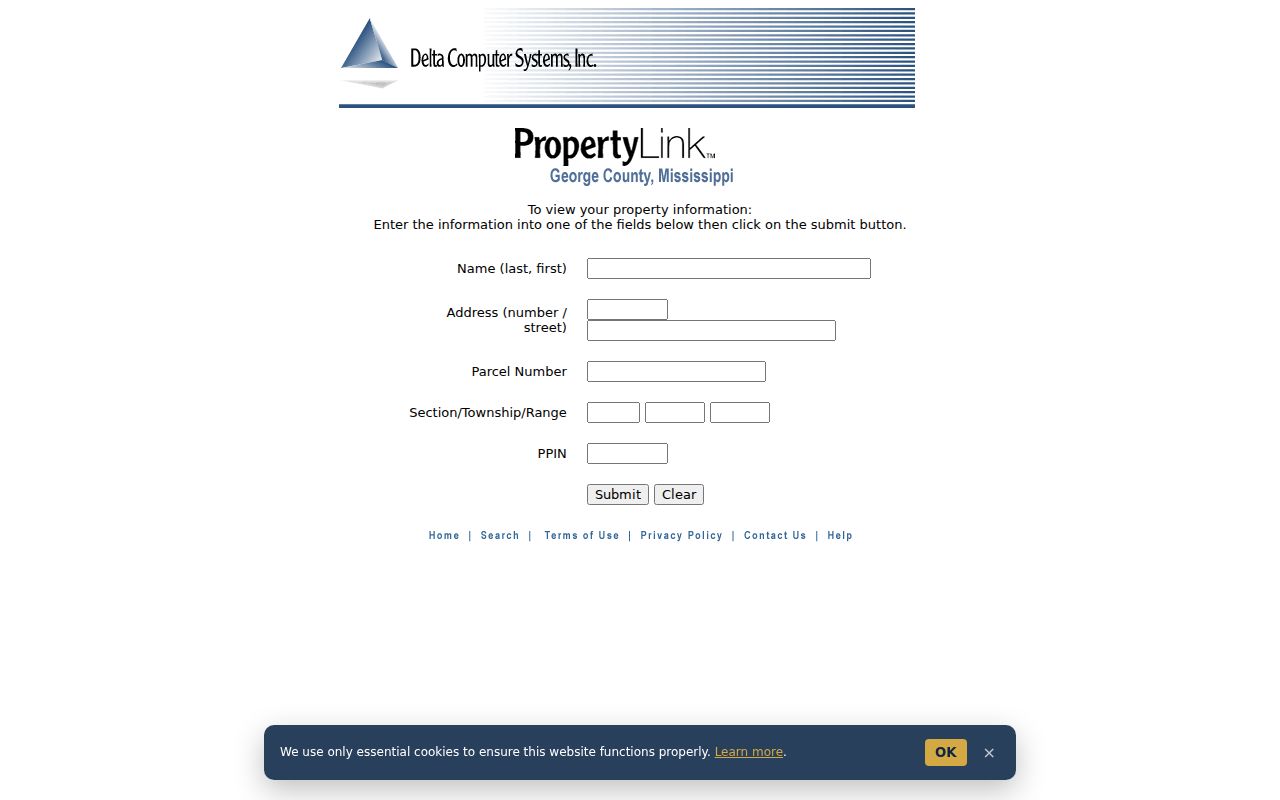
The screen offers name, address, parcel, section-township-range, and PPIN routes. An absent or stale account deserves a call or visit to the county office. Never infer that no tax is due from a blank result.
George County Homestead Filing
Mississippi's homestead filing window runs January 1 through April 1. The Department of Revenue homestead page covers eligibility, filing dates, benefit tiers, and events that trigger a new filing. George County takes local applications through the Tax Assessor/Collector. Applicants bring closing paperwork, all car-tag numbers, Social Security numbers for applicant and spouse when married, and a driver license or official ID. Those are office rules for applying in person. Keep sensitive identifiers out of general public-record requests and published notes. Exemption flags may show up in the parcel data, yet only the office decides the application. Question a missing or changed code with the assessor, citing the parcel number, filing facts, and tax year.
George County Delinquency Trail
The county GIS and tax hub links a tax-sale listing plus appraisal, tax, millage, and homestead material. Mississippi DOR allows real-estate tax sales on the first Monday in April and the last Monday in August. Treat those statewide dates as context; George County's current list and notice govern any parcel. Track a distressed account as a timeline: assessment and delinquency, notice, sale, certificate or deed, redemption or release, and later conveyance. The Chancery portal sorts these into County Tax Sale, City Tax Sale, County or City Tax Deed, releases, redemption, and land sold for taxes. A delinquent bill alone proves no transfer of ownership. Ask the Tax Collector for the current list, notice, payment rules, and redemption state. The clerk handles whatever gets recorded next. Date every result, since payment and redemption status shift.
George County Tax Office Move
The George County Tax Assessor/Collector relocated in 2025 to 309 Summer Street in Lucedale. The office posts 601-947-7541 and weekday hours of 8 a.m. to 5 p.m. A 2026 county headline mentioned parking work at the new office as well. Older directories may still list the prior Main Street location. A quick confirmation helps before any property tax records errand.
The office counter or phone is the right stop when a Delta result omits a parcel. It also serves when an older tax roll or certified receipt is needed. Tax-sale and redemption questions remain fair game there too. The Chancery Clerk at 355 Cox Street is the separate fallback for recorded tax deeds and releases. That office also handles delinquent land-tax matters in its scope.
Note: Confirm the current Summer Street office details before an in-person George County property tax records visit.
Contest a George County Assessment
Start with the assessor. That is the right office when a parcel's facts, classification, improvements, acreage, or value look wrong on the tax roll. Walk in with the tax notice, the parcel number and PPIN, photographs, measurements, a recent appraisal if you have one, and comparable evidence that actually speaks to your dispute. Ask plainly which field or valuation fact produced the amount you are contesting. The answer tells you what to argue.
Timing follows the state calendar. Under the Mississippi DOR process, assessment rolls go to Boards of Supervisors on the first Monday in July. Objections are then heard at the August meeting. The appeal must land by that meeting date rather than by one fixed calendar date, so confirm George County's current notice and deadline every year.
A board decision can still be appealed to Circuit Court under the state process. That path is separate from disputing how a tax payment posted, or from attacking a finished tax-sale instrument. Each dispute belongs to the keeper of that record.
Sort your evidence into two piles. Factual corrections, such as a wrong acreage, improvement description, class, exemption, or parcel link, should name the roll field and cite a source that backs the fix. A value objection is different. It needs evidence tied to the appraisal date, not just a later asking price. Keep copies of everything: the notice, your written objection, exhibits, the board's action, and any court filing. The tax portal warns about uploads, so save a dated capture in case the public screen shifts during review.
When a portal view falls short, the Mississippi Public Records Act opens another route to existing, nonexempt assessment records. Address the request to the Tax Assessor/Collector. Identify the parcel, the PPIN, the tax year, the record you want, and your preferred format, then ask for a fee estimate. The office will not produce a fresh appraisal or a legal opinion. A narrow request, though, can retrieve an existing roll card, a tax receipt, an exemption record subject to privacy limits, or documentation of board action.
Appeal window. Check the George County roll notice promptly. Mississippi's process centers on the Board of Supervisors' August meeting, and the annual local date controls.